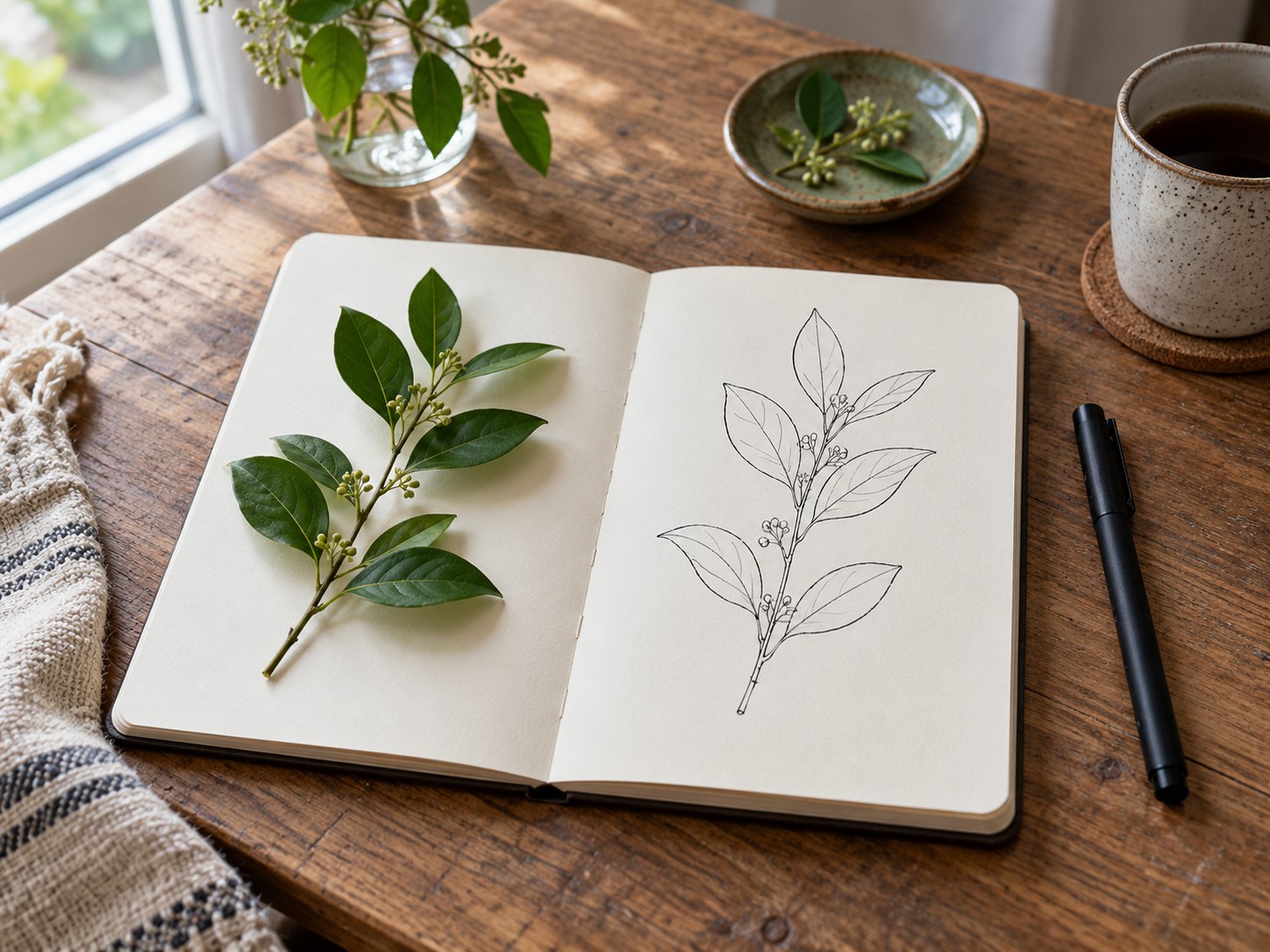
Choose a leaf or small stem you can observe calmly, without collecting protected plants or handling an unfamiliar irritating species. A photograph you took can also work. Put the subject against a simple background and look at its overall silhouette. The first question is not the shape of every vein but the direction of the stem and the position of its leaves.
Take paper, a pencil and perhaps an eraser. A pen can come later. Lightly mark the main axis, then the points where leaves attach. Some face you and others turn sideways; do not draw them all as identical shapes at regular intervals unless that is actually what you see.
Draw the spaces between leaves
Look at the empty space between two leaves. Its shape helps you understand their directions. Draw the larger forms first with light pressure, leaving room for correction. Return your gaze to the subject after a few marks rather than continuing from memory. You can simplify without inventing symmetry that is not there.
Then add a central vein to leaves that need one to read clearly. Not every detail deserves equal precision. A foreground leaf may receive more attention while another remains an outline. If going over the drawing in pen, test it on scrap paper and wait until it dries before erasing construction lines.
For a second drawing, turn the stem but keep the same materials. Compare what becomes visible or hidden. This small movement shows that the subject is not a fixed symbol. Complex shading is not necessary for an interesting study, and a clear outline can convey how a leaf bends.
Add the date and the plant's name only if you genuinely know it. Otherwise describe it without inventing an identification. Keep early trials: they reveal your choices and the details you are learning to notice. You can eventually use a drawing as a card motif, but let it exist first as an observation without immediately needing to become a finished object.