Choose one constraint
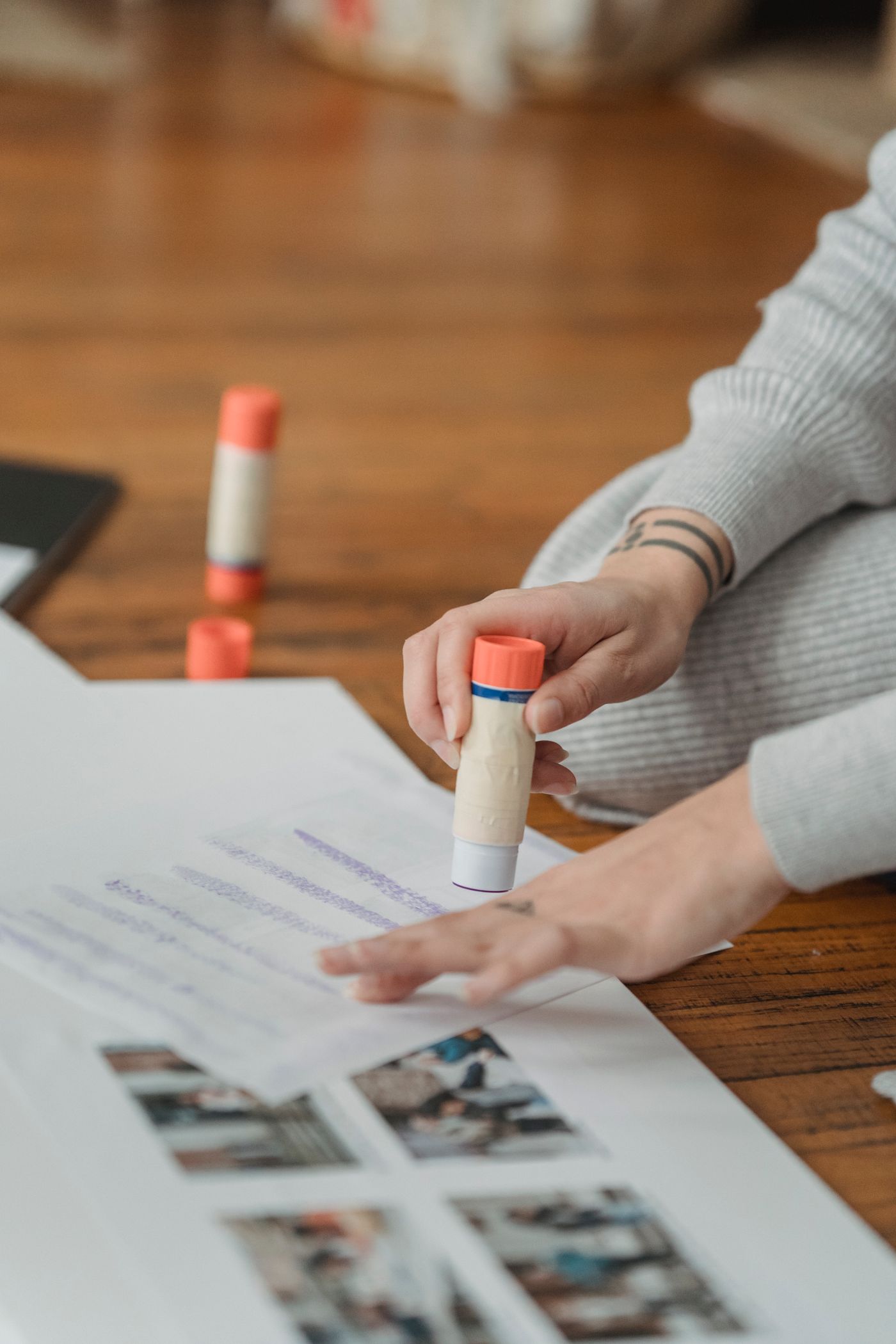
Gather a reasonably thick backing sheet, paper you already have, scissors appropriate for everyone involved and glue intended for paper. Protect the table with a reusable surface. Avoid bringing out your entire collection: an envelope of scraps, two magazines and some clean packaging already provide plenty of choices.
Choose one constraint. Work with two colours, build an imaginary house or contrast circles with straight lines. The constraint is not an aesthetic rule you must follow perfectly. It mainly helps you start instead of searching indefinitely among every possible idea. Give yourself permission to change a detail once the composition begins to develop.
Arrange before sticking
Cut or tear pieces in different sizes. Place large shapes first and add a few details afterwards. Leave empty areas so individual elements remain readable. Photograph an initial arrangement if you want to try another version without losing the starting point.
When satisfied, lift and glue the pieces one at a time. Use glue sparingly and follow the product instructions. Very thin paper may wrinkle, so test a scrap before covering a large area. If something tears, consider incorporating the tear instead of rebuilding the entire composition. Overlaps and irregular edges can become part of the arrangement rather than defects to hide.
Finish without continually adding
Move the collage farther away and notice where your attention goes. If several areas compete to be the main focus, remove an element before adding another. A title may clarify the idea but is optional. You can simply date the back and leave the image without an explanation.
Let it dry flat, beyond young children's reach when glue or small pieces create a risk. Keep useful leftovers in one envelope and recycle scraps you will not use. For work you intend to publish or sell, use images with appropriate rights; cutting them out does not make them free to reuse. Abstract shapes and your own drawings offer plenty of material without relying on someone else's photographs.