Prepare one trial version
Use two equal paper rectangles for each star. Paper flexible enough to fold but not extremely thin is easier for a first attempt. Add a ruler, pencil, suitable scissors and paper glue. Protect the table and keep small fixings away from young children.
Make a prototype before preparing a whole collection. It lets you check rectangle proportions and fold thickness. Do not begin with your most precious paper: early attempts also show how the two halves meet. Record the dimensions that work so later stars can repeat the construction without guessing every measurement again.
Create two folded fans
Mark evenly spaced strips across the first rectangle and fold them like an accordion, alternating forward and backward folds. Repeat with the second rectangle using the same spacing. Fold each accordion in half to make a fan joined at its centre.
Cut the ends at an angle to create points, working slowly with scissors suitable for the thickness. If the folded bundle is too thick, do not force the cut. Use thinner paper or cut a smaller amount at once. Children may prepare folds while an adult handles difficult cutting. Matching the two sets of points matters more than achieving a very sharp tip.
Join and open
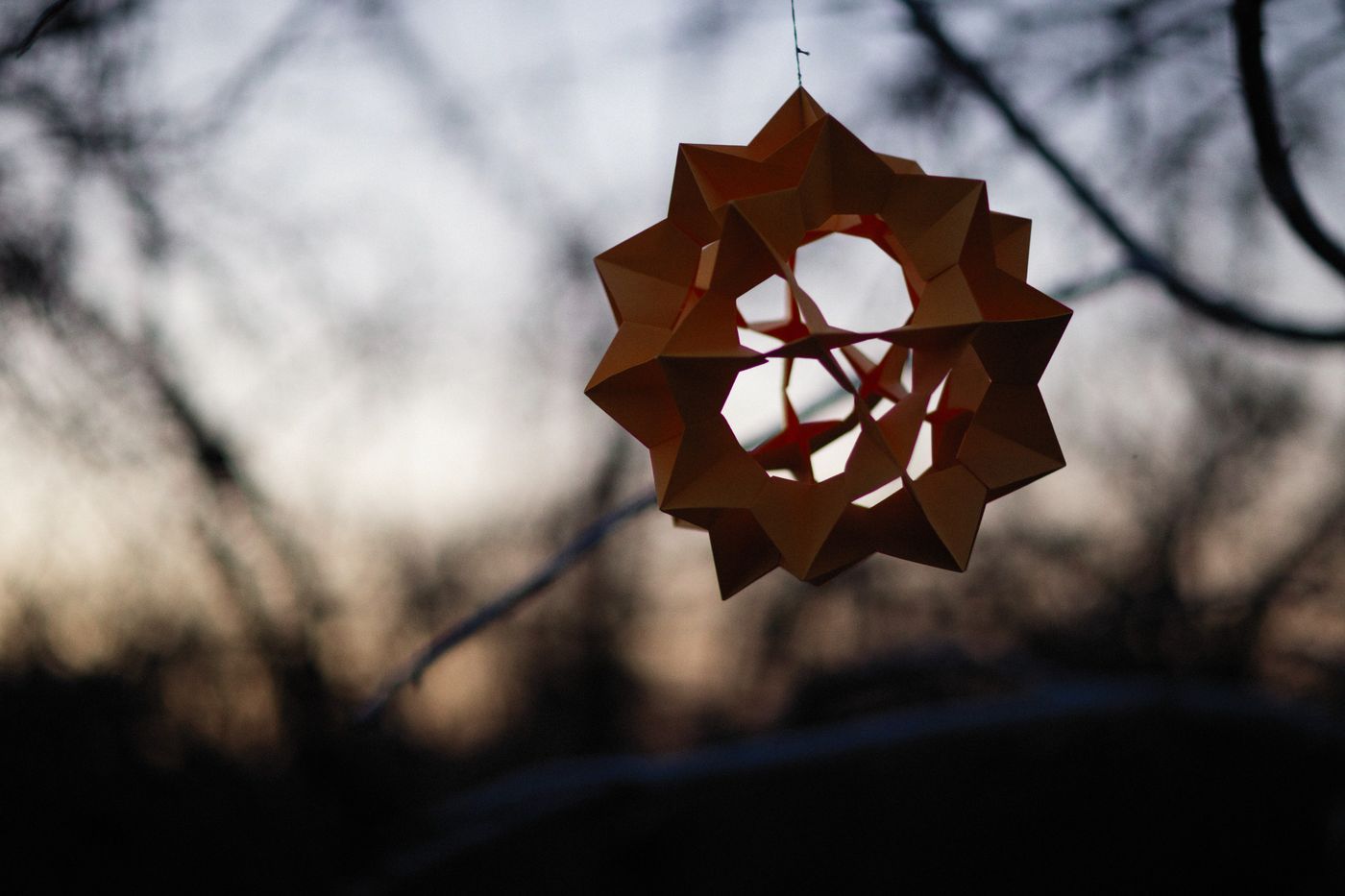
Glue the inner faces of each fan according to product instructions, then join the two halves into a star-shaped wheel. Allow joints to dry before handling. Open the folds gradually because pulling suddenly on a point can tear the paper.
Attach a hanging tie at a reinforced position, without making a long loop accessible to young children. Stars can also stand against a background rather than hang. If the shape buckles, check fold consistency and glue quantity before rebuilding the entire model. A slight irregularity is not necessarily worth damaging the piece by trying to pull it straight.
Keep paper away from heat
These remain paper ornaments, so keep them away from candles, hot radiators and lighting whose ventilation they might obstruct. Do not put a bulb inside a handmade star that was not designed as a lampshade. Use a fixing suitable for the surface and avoid routes where someone could catch or pull it.
Protect points in a shallow box for storage. Some versions can fold down when designed with a removable closure, but do not force a completely glued star shut. Retaining the successful prototype dimensions lets you change colours another year without repeating all the proportion tests.